
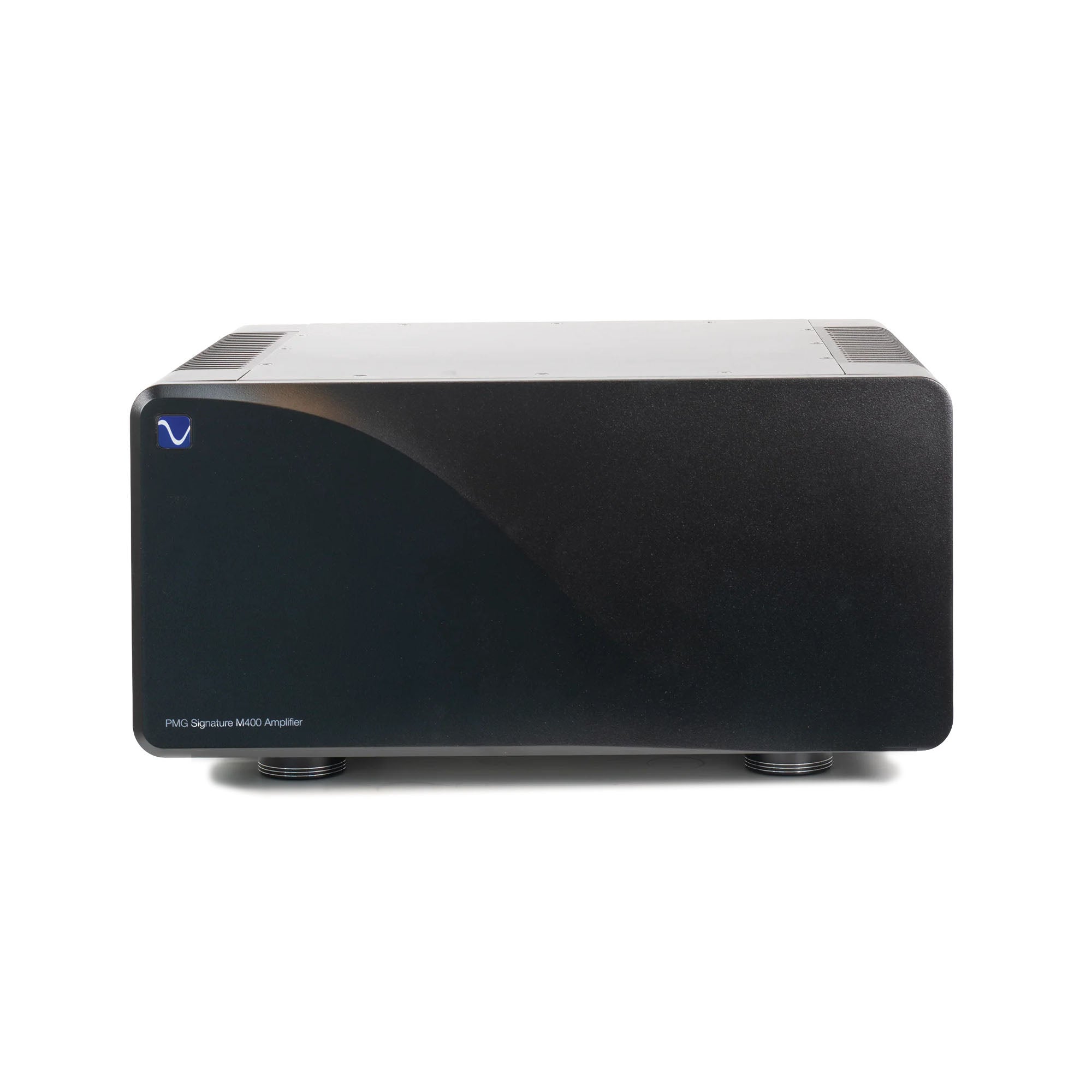
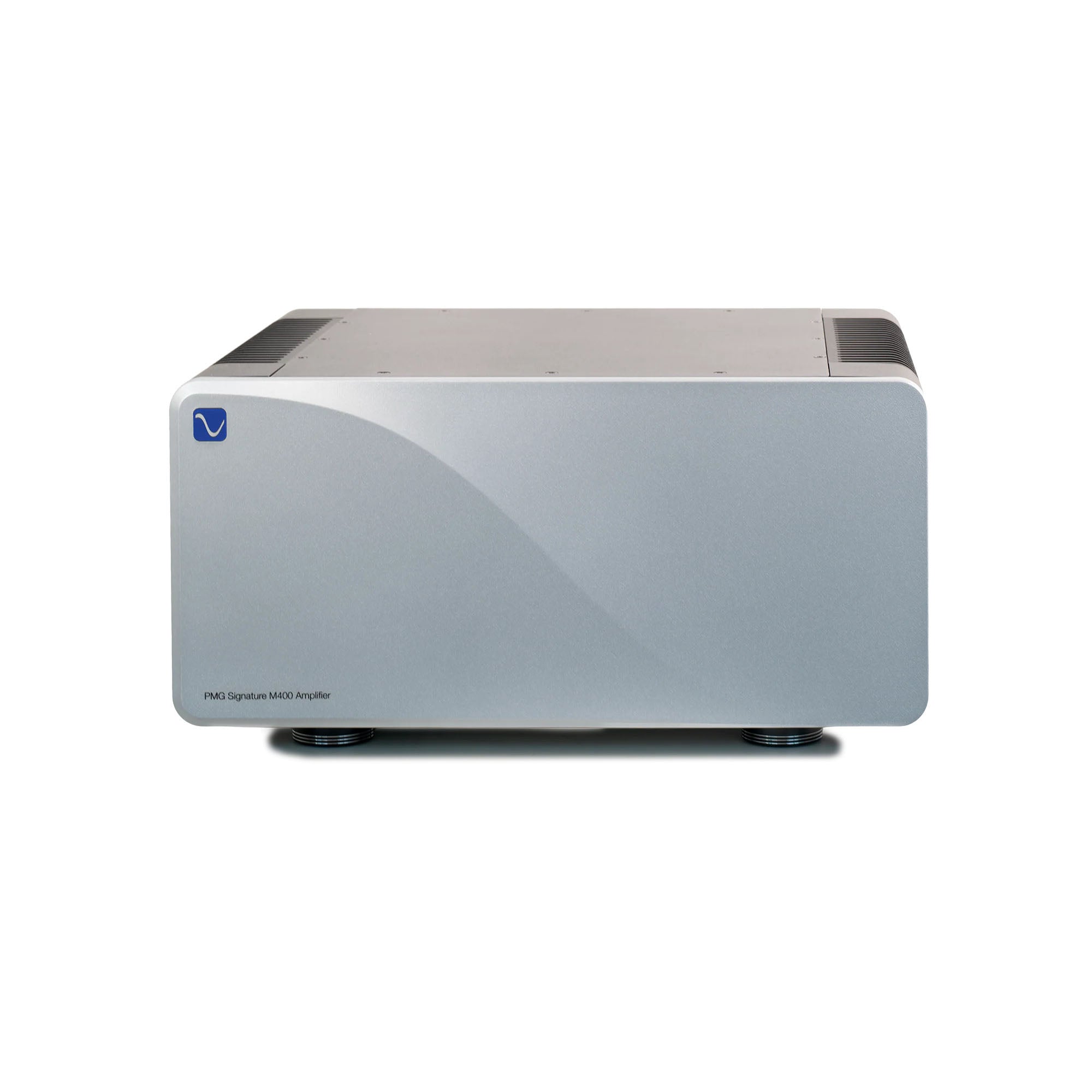
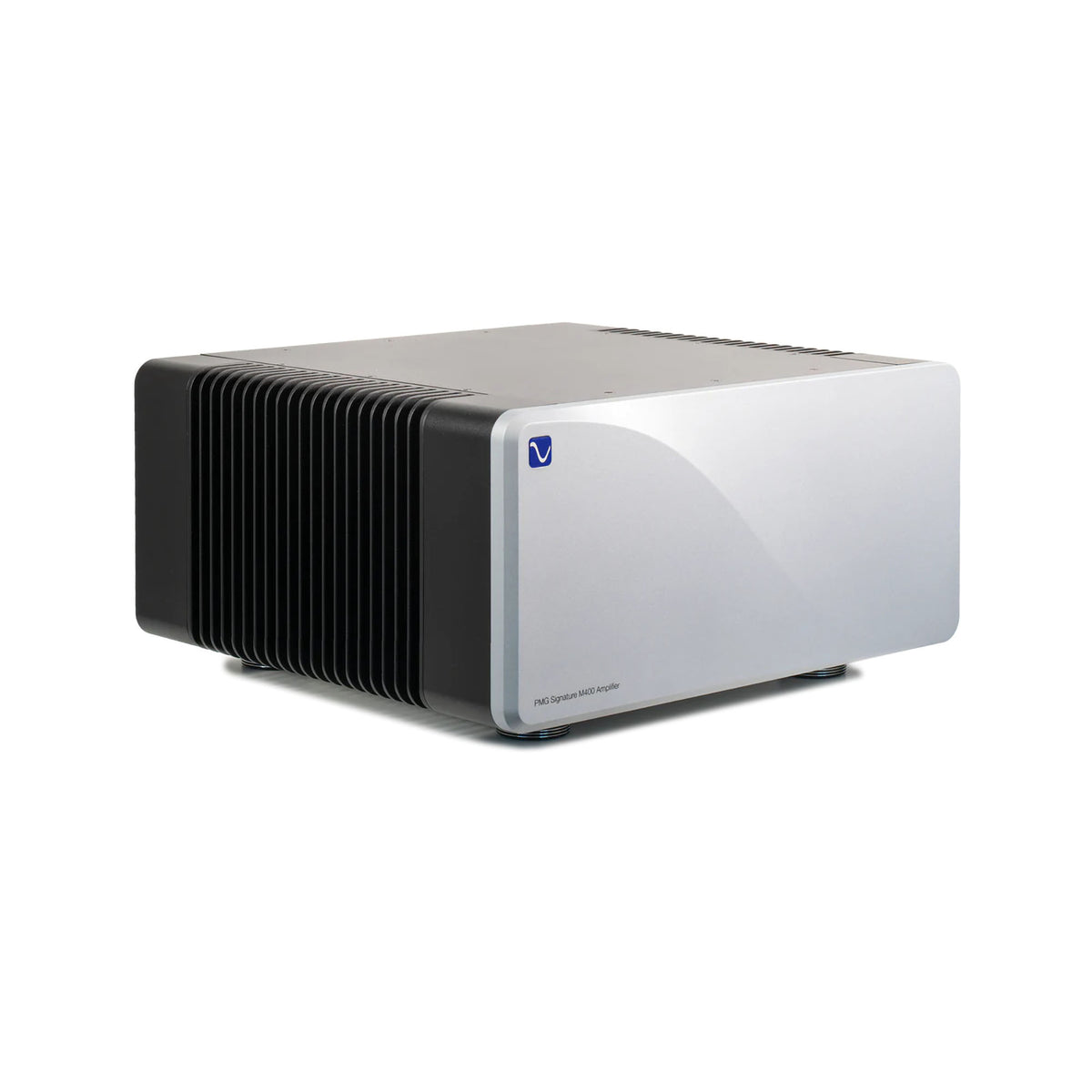
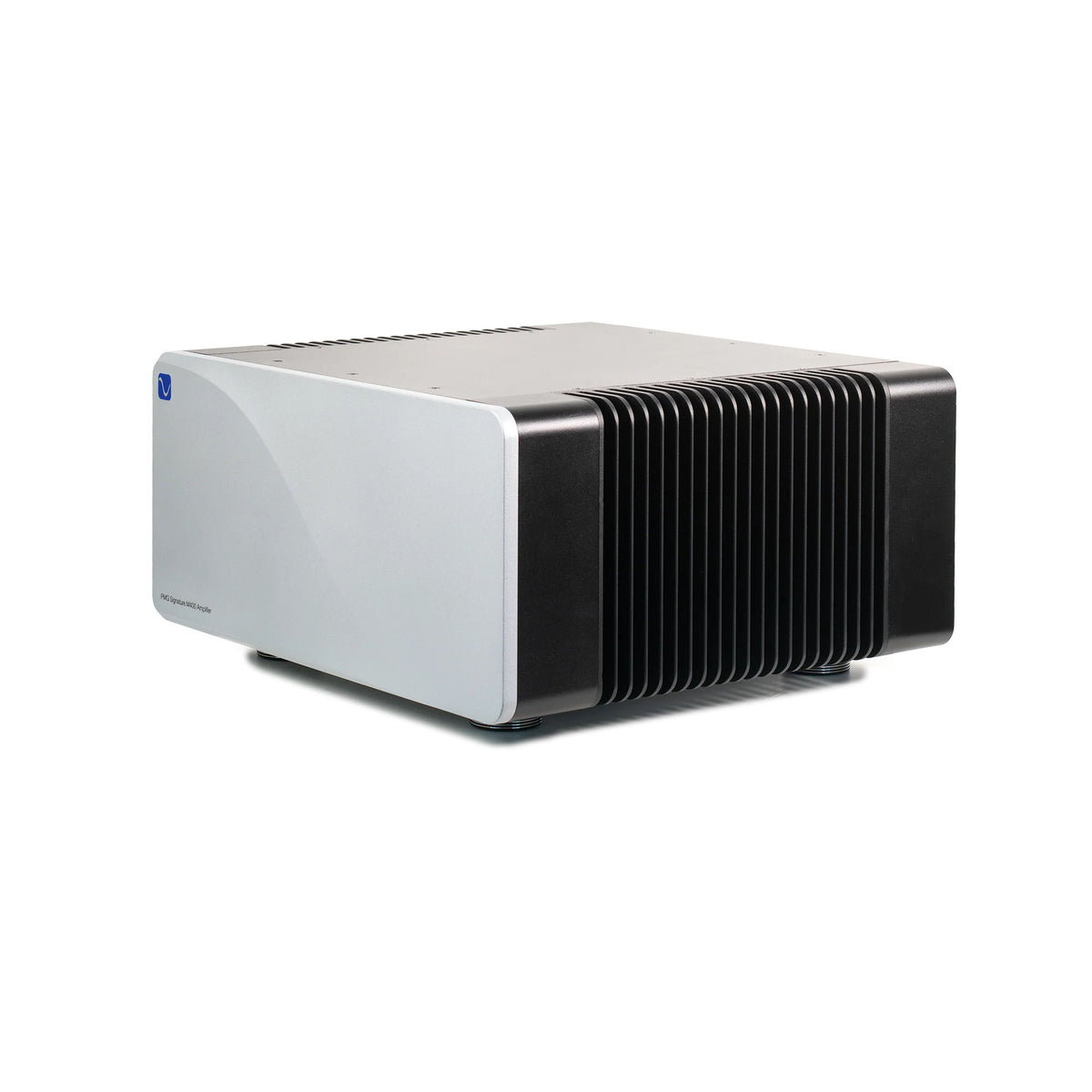
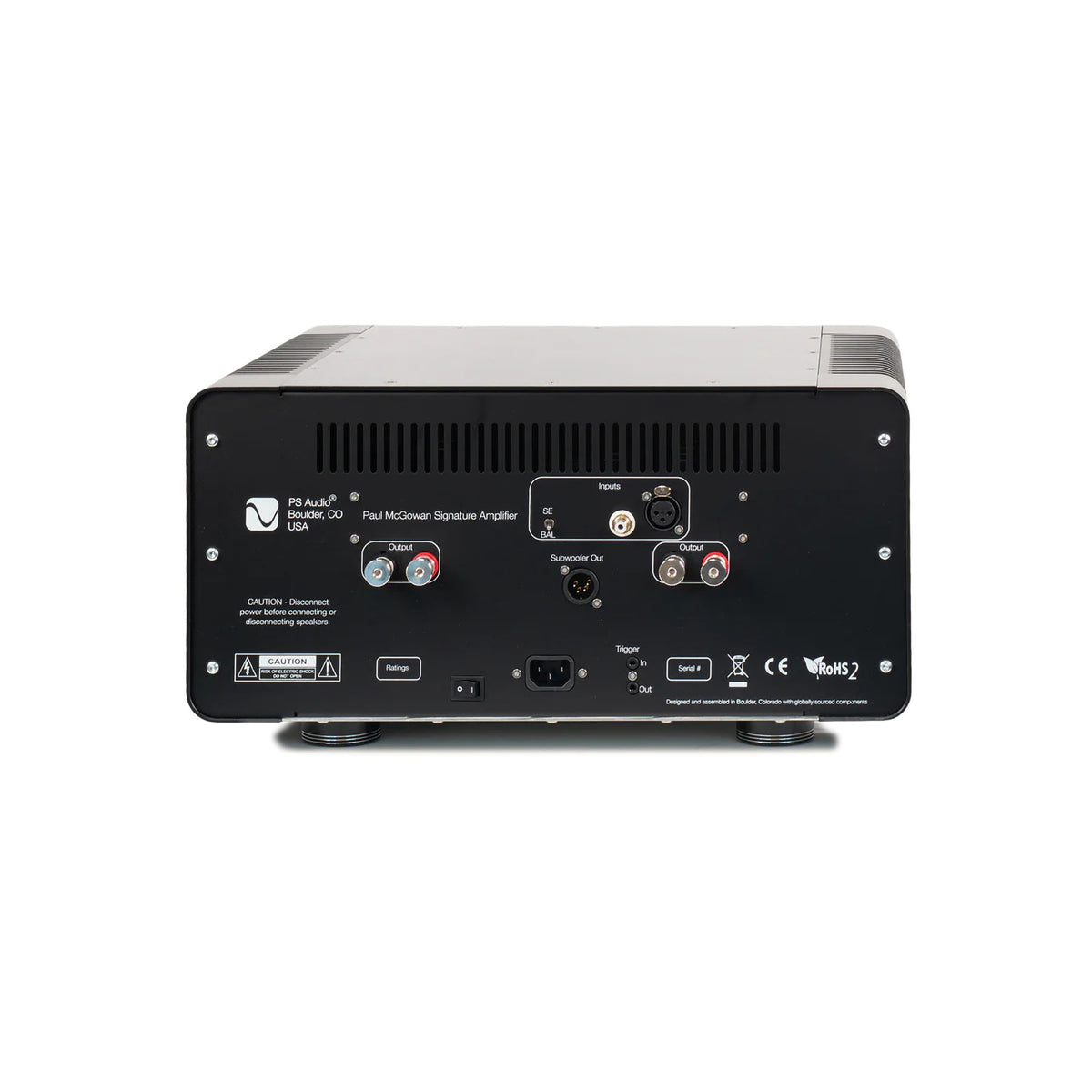
PS Audio PMG M400 Monoblock Signature Power Amplifier (pair)
Available from
The PMG Signature voice in a more accessible stereo chassis.
Reference-class monoblock power. The M400's design DNA, scaled for the systems most reference listeners actually live with.
We audiophiles spend years searching for one particular amplifier. Not the statement piece — the reference. The one that does everything right, asks nothing in return, and never reminds you it is there. The M400 is that amplifier.
It carries the PMG M800's design DNA intact: Darren Myers' strikingly low-feedback topology, and a state-of-the-art active power supply that delivers current the instant the music asks for it. Thirty watts of pure Class A bias hold it in its most linear region across roughly sixty percent of typical listening. Two hundred watts into 8 ohms, doubling to 400 into 4 — effortless authority on virtually any loudspeaker worth driving.
The same speed lives here, too: bandwidth beyond 500 kHz, slew rate past 200 volts per microsecond, a 10 kHz square wave returned with edges as clean as if drawn with a ruler. Distortion stays flat across the audible band.
The M400 does not reach for reference performance. It defines it. Sold as a pair. Designed by Darren Myers. Engineered to perfection by Bob Stadtherr. Hand-built in Boulder, Colorado.
Features
- 200 watts into 8Ω, doubling to 400 watts into 4Ω
- 30W Class A bias
- Slew Rate > 200V/uS
- Bandwidth exceeding 500 kHz
- Strikingly low overall feedback architecture
- State-of-the-art active power supply
- Designed by Darren Myers
- Engineered by Bob Stadtherr
Design
The M400 inherits the M800's engineering philosophy intact. At its heart is the same state-of-the-art active power supply approach — active pure power in place of a passive transformer — paired with Darren Myers' strikingly low-feedback topology. The difference between the M400 and the flagship is not one of design integrity but of scale: the M400 is built to deliver reference-grade performance into the power envelope a real-world system actually uses. Assembled by hand in Boulder, Colorado, and brought to perfection by Bob Stadtherr.
Application
The M400 is a monoblock, sold as a pair for stereo. Two hundred watts into 8 ohms — doubling to 400 into 4 — is enough authority for the overwhelming majority of high-performance loudspeakers, from efficient floorstanders to demanding modern transducers. It is the natural choice for the listener who wants genuine reference monoblock performance without the scale, or the cost, of the flagship. For most rooms and most speakers, the M400 will never be the limiting factor in the system.
Class A purity
There is a number on most amplifier spec sheets that deserves far more scrutiny than it gets: the amount of pure Class A bias. Class A is the most linear mode an amplifier can operate in — every transistor conducting through the whole waveform, no crossover point, no handoff, no discontinuity. It is also the most costly, because a Class A stage runs hot and consumes power even at idle. So most amplifiers ration it severely. It is rare for a high-end design to offer even a single watt of true Class A before it slips into the compromises of Class AB — and many that proudly wear the "Class A" label give you only a fraction of one.
The M400 carries 30 watts of pure Class A bias. At the modest power levels where real music actually lives, that 30-watt window covers roughly 60% of normal listening — the great majority of every record you play. Within it, the amplifier never leaves its purest operating mode: no crossover distortion, no class-switching artifacts, no subtle shift in character as the volume rises and falls.
The result is what listeners mean when they describe an amplifier as "natural" — microdynamic detail that survives intact, instrumental textures that sound like the instruments themselves rather than an electronic approximation of them. The M400 does not borrow that quality from the flagship. It is built with it.
Power scaled
Every quality an amplifier is praised for — its authority, its quiet, its sense of effortless control — traces back to one place: the power supply. It is the reservoir the music draws from, and the speed and cleanliness of that reservoir shapes the sound more than almost any other decision a designer makes. For half a century the industry has built that reservoir the same way: a large linear transformer feeding banks of capacitors. It works. But the transformer is the slowest element in the entire signal path, the capacitors cannot return charge without ripple, and the rectifier adds a burst of switching noise every time it conducts.
The M400 is built on a state-of-the-art active power supply — the same architecture that powers the M800, scaled precisely to the M400's 200-watt-into-8-ohm output. "Scaled" is the important word: nothing about the supply's behavior was compromised, only its size. It still delivers current the instant the output stage calls for it, with no rectifier noise, no sag under sustained load, and a residual noise floor low enough to leave the quietest passages genuinely silent.
That is why the M400 doubles its power cleanly into 4 ohms — 400 watts, on demand — without strain. Clean power doubling into a halving impedance is the audible signature of a supply with real reserves. The M400 has them, and it keeps its composure whether the music asks for a whisper or a wall of sound.
The PMG disappears into the Music
There is a measurement most amplifier makers are proud to quote: total harmonic distortion, driven to a vanishingly small number. What the number rarely reveals is how it was achieved. The usual method is large amounts of negative feedback — a correction loop wrapped around the output stage, constantly measuring its error and cancelling it. On a steady test tone, it works beautifully. On music, which is all transients and never steady, the correction always lags a little behind, and the cost is paid in harshness: the leading edge of a note hardens, the sense of a live event glares.
The M400 reaches its low distortion a different way. Darren Myers' topology is engineered to be highly linear before any feedback is applied at all — so only a small, gentle amount is needed to finish the job. This is what "strikingly low overall feedback" means in practice: not an amplifier that distorts more, but one that had far less to correct from the start.
The audible result is a signal path that stays open. Bandwidth extends well beyond 500 kHz, so transients pass through unhurried and uncolored. There is no phase smear, no faint haze of correction artifacts to surface later as listening fatigue. The M400 simply gets out of the way — and the longer you listen, the more clearly you understand that getting out of the way is the single hardest thing an amplifier can be asked to do
Independently verified across the tests that separate good amplifiers from great ones.

Distortion vs. Frequency
Distortion vs. Frequency — This measurement tracks total harmonic distortion across the entire audio band, from 20 Hz to 20 kHz, under four conditions: no load, 8 ohms, 4 ohms, and a punishing 2 ohms. The traces do vary — distortion climbs gently with frequency, and the hardest 2-ohm load runs highest — but the takeaway is simple. Even at its worst, the PMG's distortion stays a tiny fraction of one percent, far below the level of audability. Linearity held this tight, across every load, and achieved without adding negative feedback, is something perhaps one amplifier in a hundred can claim — which means distortion simply stops being part of the conversation.

Twin tone Intermodulation results
Twin tone Intermodulation results — Here the amplifier is fed two tones at once — 19 kHz and 20 kHz — and we look for everything it adds that shouldn't be there. An amplifier that isn't perfectly linear lets those two tones beat against each other and spawn entirely new frequencies that have no musical relationship to the original signal. Those added tones are precisely what the ear registers as harshness, grain, and listening fatigue. The PMG produces almost none — the spectrum is essentially just the two original tones and silence. That is the measurable fingerprint of sound that stays clean and natural no matter how dense or demanding the music becomes.

10kHz square wave response
10kHz square wave response — A square wave is the cruelest signal you can hand an amplifier; it demands instantaneous swings in output voltage. Reproducing one cleanly takes tremendous speed — measured as slew rate — and the PMG Signature series exceeds 200 volts per microsecond. You can see the result here: vertical edges, flat tops, no overshoot, no ringing. Real music is full of fast transients — the leading edge of a cymbal, the snap of a plucked string — and an amplifier too slow to follow them rounds those transients off and smears the detail. The PMG follows all of it. In fifty years of designing amplifiers, we have never measured a square wave this perfect.
Product Specifications
Unit Weight
55.8 lbs (25.3 kg)
Unit Dimensions
16 × 17.5 × 8 in (406.4 × 444.5 × 203.2 mm)
Dimensions (with Feet & Binding Posts)
16.75 × 17.5 × 8.75 in
Shipping Weight
68 lbs (per unit)
Shipping Dimensions
23.5 × 23 × 15 in (596.9 × 584.2 × 381 mm, 2 units)
Input Power
Auto Voltage
120VAC or 230VAC, 50/60Hz
Power Consumption
Standby
<2W • Idle
220W • 50W/4Ω
320W
Fuses
No user-serviceable fuses
Audio Inputs
1 × RCA (Single-ended), 1 × XLR (Balanced)
Speaker Outputs
2 pairs of silver-plated binding posts
Trigger
Input
3.5mm (5–15VDC) • Output
3.5mm (12VDC)
Gain
26.2dB
Input Sensitivity
2.0V
Power Output
200W into 8Ω, 400W into 4Ω (1kHz, <1% THD)
Class A Power Output
30W into 8Ω
Frequency Response
<10Hz – 80kHz (±0.25dB)
Input Impedance
100kΩ (Single-ended), 200kΩ (Balanced)
Bandwidth
>500kHz
Total Harmonic Distortion (THD)
<0.002% typical (20Hz–20kHz, 1W/8Ω)
Damping Factor
>300 at 8Ω (20Hz–1kHz)
Choose options