
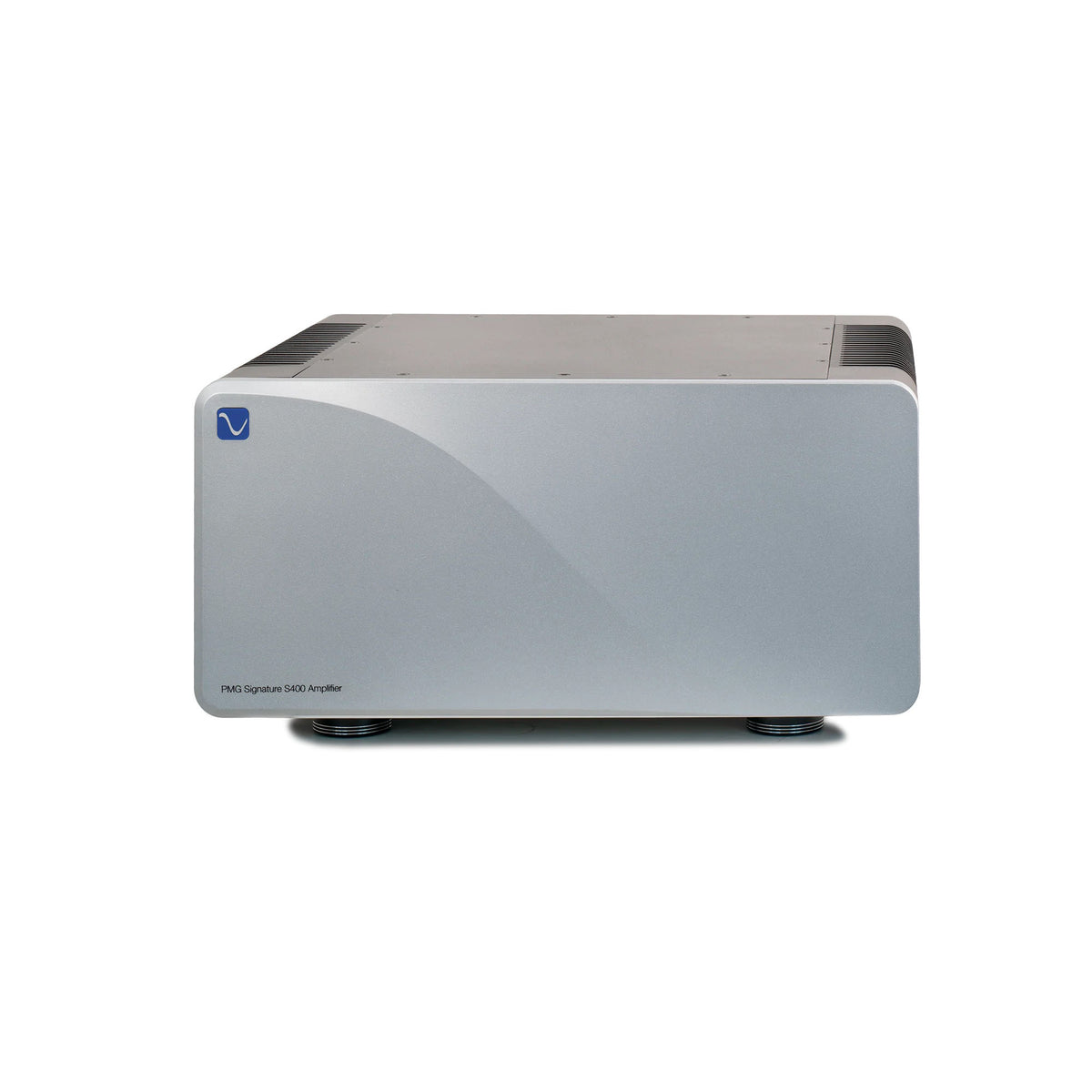
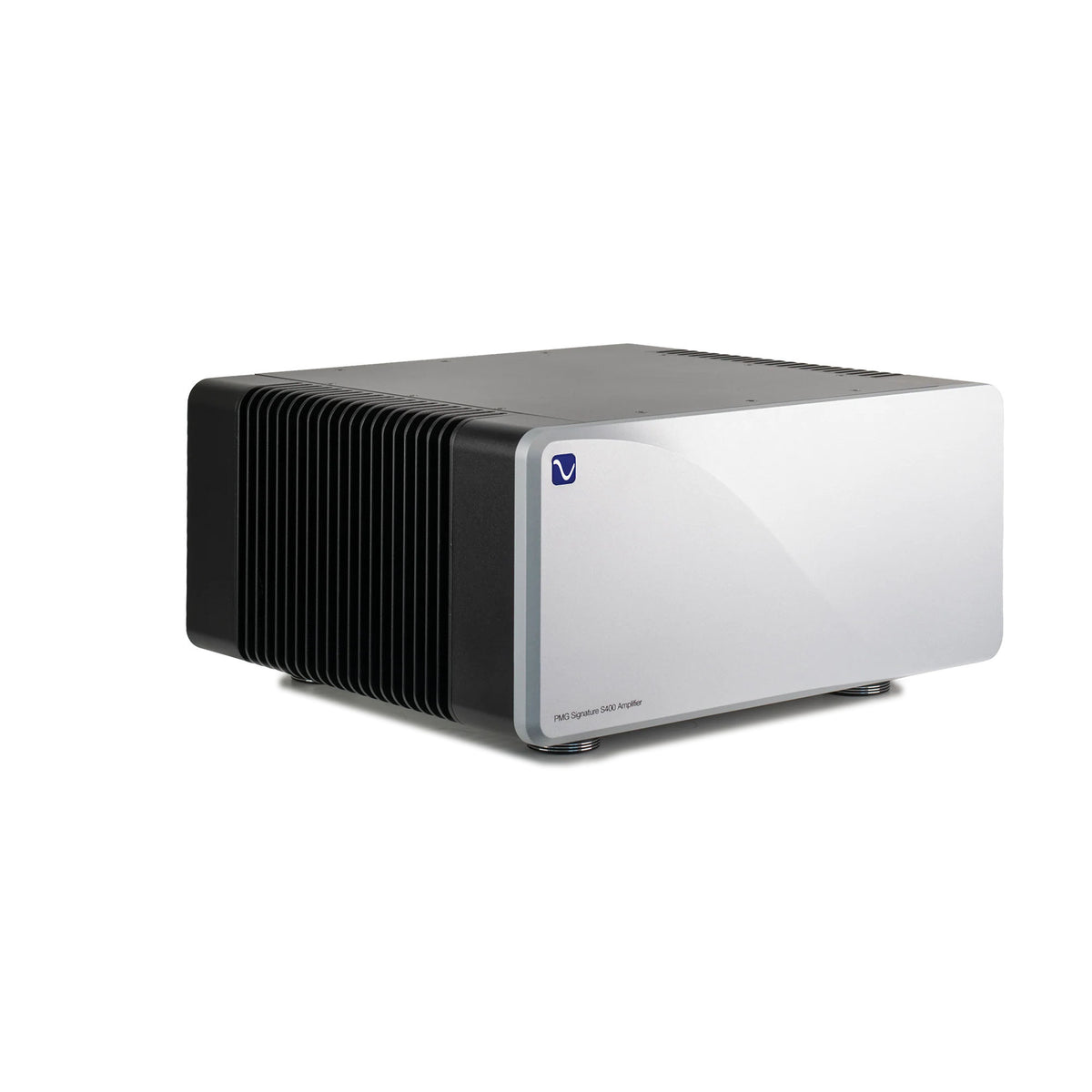
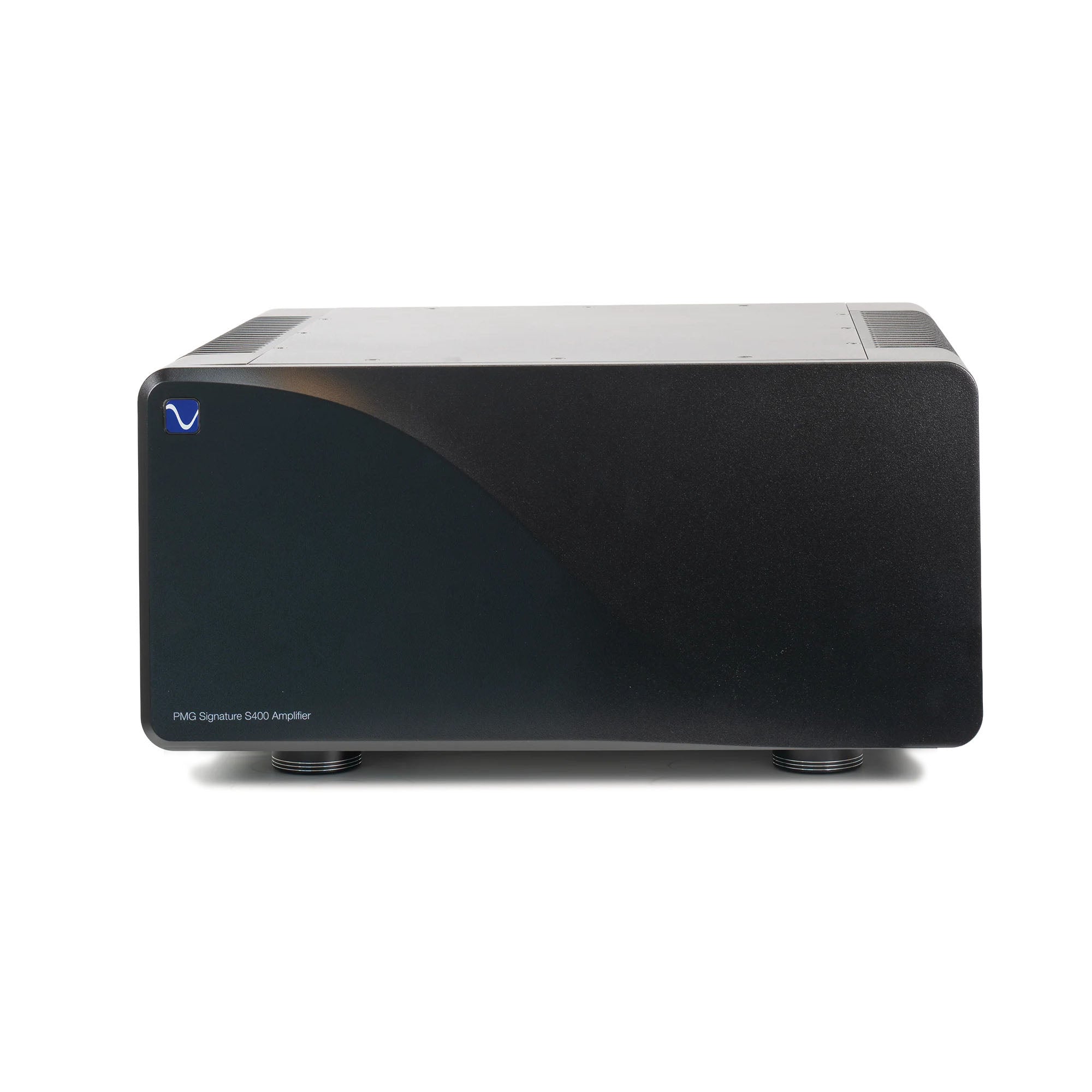
PS Audio PMG S400 Stereo Power Amplifier
Available from
The PMG Signature voice in a more accessible stereo chassis.
Not every great system has room for two amplifiers. Two boxes, two power cords, two sets of cables — for many listeners that is one requisite too many. The S400 exists for them: the entire PMG Signature experience in a single chassis.
What it is not is a compromise of sonics. This is the full Signature topology built in stereo form — two channels of 200 watts each into 8 ohms, doubling cleanly into 4, drawn from the same state-of-the-art active power supply architecture that drives the M400. The same strikingly low overall feedback. The same bandwidth beyond 500 kHz and slew rate past 200 volts per microsecond — the speed that returns a flawless 10 kHz square wave and lets every transient land exactly when the music intended. The same flat, low distortion across the audible band.
Little in the topology was pared back. One box, one power cord, two channels of genuine reference amplification. Designed by Darren Myers. Engineered by Bob Stadtherr. Hand-built in Boulder, Colorado.
Features
- 200 watts into 8Ω per channel, doubling to 400 watts into 4Ω per channel
- 10W Class A bias per channel
- Slew Rate > 200V/uS
- Bandwidth exceeding 500 kHz
- Strikingly low overall feedback architecture
- State-of-the-art active power supply
- Designed by Darren Myers
- Engineered by Bob Stadtherr
Design
The S400 places two complete PMG Signature channels in a single chassis — and the engineering challenge was making sure neither channel ever knows the other is there. Each channel runs from the same state-of-the-art active power supply architecture as the monoblocks, with the internal layout and isolation engineered so that one channel's demands only minutely disturb the other's signal. Darren Myers's low-feedback, high slew rate topology is carried over without compromise. Hand-assembled in Boulder, Colorado, and brought to perfection by Bob Stadtherr.
Application
The S400 is a single stereo chassis with a single power cord — the Signature experience without two boxes on the floor. Two hundred watts per channel into 8 ohms, doubling into 4, will comfortably drive the great majority of high-quality loudspeakers in rooms of moderate to generous size. It suits the listener who wants genuine reference amplification but values simplicity, space, and a clean installation as much as ultimate output.
Class A purity
Ask an amplifier designer what separates a merely good output stage from a truly transparent one, and the conversation will arrive, quickly, at Class A. In Class A operation every transistor conducts through the entire waveform and never switches off — no crossover point, no handoff between devices, no discontinuity for the music to cross. It is the most linear mode of amplification there is. It is also the most demanding: a Class A stage runs hot and draws power continuously, even in silence. That cost is why genuine Class A is so scarce. It is rare for a high-end amplifier to provide even a single watt of true Class A, and many that claim the term operate purely in it for only a fraction of a watt.
The S400 dedicates 10 watts of pure Class A bias to each of its two channels. In a stereo chassis — where two channels must share one enclosure and one thermal budget — that is a serious commitment. Those 10 watts per channel cover the quiet, low-level passages where the ear is at its most revealing and least forgiving: the inner detail of a recording, the decay of a note into a room, the texture of a voice held softly. It is precisely there, in the delicate material, that crossover artifacts are most audible and most fatiguing — and precisely there that the S400 stays pure. Both channels carry the same operating integrity as a PMG Signature monoblock, in a single chassis that asks for none of the compromises you would expect.
Two channels, one design
Building a stereo amplifier that truly rivals a pair of monoblocks is harder than it sounds, and the reason comes down to one shared resource: the power supply. In a stereo chassis, both channels draw from it. When the left channel demands a sudden surge of current — a drum strike, a crescendo — that demand pulls on the supply the right channel is using too. On a conventional amplifier the supply voltage dips under the load, and the second channel is dragged a fraction off course. You can measure it as crosstalk; sometimes you can hear it, as a soundstage that narrows when the music turns complex. It is the historical reason monoblocks have long been considered the purer choice.
The S400 closes that gap, and it begins with the power supply itself. A state-of-the-art active power supply delivers far cleaner power, and far greater current on demand, than any traditional transformer-based design — and it holds its output stiff under load. When one channel slams it with a transient, it sags very little, so the other channel sees only the smallest of the disturbance.
The rest is layout. Bob Stadtherr, drawing on decades of amplifier engineering, arranged the S400's grounding, board topology, and mechanical structure so the two channels' currents never intermingle and neither can couple into the other. An active supply that rarely sags, and a layout engineered channel by channel: together they bring the S400 remarkably close to the separation of true monoblocks — 200 watts into 8 ohms per channel, doubling cleanly to 400 into 4, from a single chassis with a single power cord.
Independently verified across the tests that separate good amplifiers from great ones.

Distortion vs. Frequency
Distortion vs. Frequency — This measurement tracks total harmonic distortion across the entire audio band, from 20 Hz to 20 kHz, under four conditions: no load, 8 ohms, 4 ohms, and a punishing 2 ohms. The traces do vary — distortion climbs gently with frequency, and the hardest 2-ohm load runs highest — but the takeaway is simple. Even at its worst, the PMG's distortion stays a tiny fraction of one percent, far below the level of audability. Linearity held this tight, across every load, and achieved without adding negative feedback, is something perhaps one amplifier in a hundred can claim — which means distortion simply stops being part of the conversation.

Twin tone Intermodulation results
Twin tone Intermodulation results — Here the amplifier is fed two tones at once — 19 kHz and 20 kHz — and we look for everything it adds that shouldn't be there. An amplifier that isn't perfectly linear lets those two tones beat against each other and spawn entirely new frequencies that have no musical relationship to the original signal. Those added tones are precisely what the ear registers as harshness, grain, and listening fatigue. The PMG produces almost none — the spectrum is essentially just the two original tones and silence. That is the measurable fingerprint of sound that stays clean and natural no matter how dense or demanding the music becomes.

10kHz square wave response
10kHz square wave response — A square wave is the cruelest signal you can hand an amplifier; it demands instantaneous swings in output voltage. Reproducing one cleanly takes tremendous speed — measured as slew rate — and the PMG Signature series exceeds 200 volts per microsecond. You can see the result here: vertical edges, flat tops, no overshoot, no ringing. Real music is full of fast transients — the leading edge of a cymbal, the snap of a plucked string — and an amplifier too slow to follow them rounds those transients off and smears the detail. The PMG follows all of it. In fifty years of designing amplifiers, we have never measured a square wave this perfect.
Product Specifications
Unit Weight
57.2 lbs (25.9 kg)
Unit Dimensions
16 × 17.5 × 8 in (406.4 × 444.5 × 203.2 mm)
Dimensions (with Feet & Binding Posts)
16.75 × 17.5 × 8.75 in
Shipping Weight
68 lbs
Shipping Dimensions
23.5 × 23 × 15 in (596.9 × 584.2 × 381 mm)
Input Power
Auto Voltage
120VAC or 230VAC, 50/60Hz
Power Consumption
Standby
<2W • Idle
190W • 50W/4Ω
390W
Fuses
No user-serviceable fuses
Audio Inputs
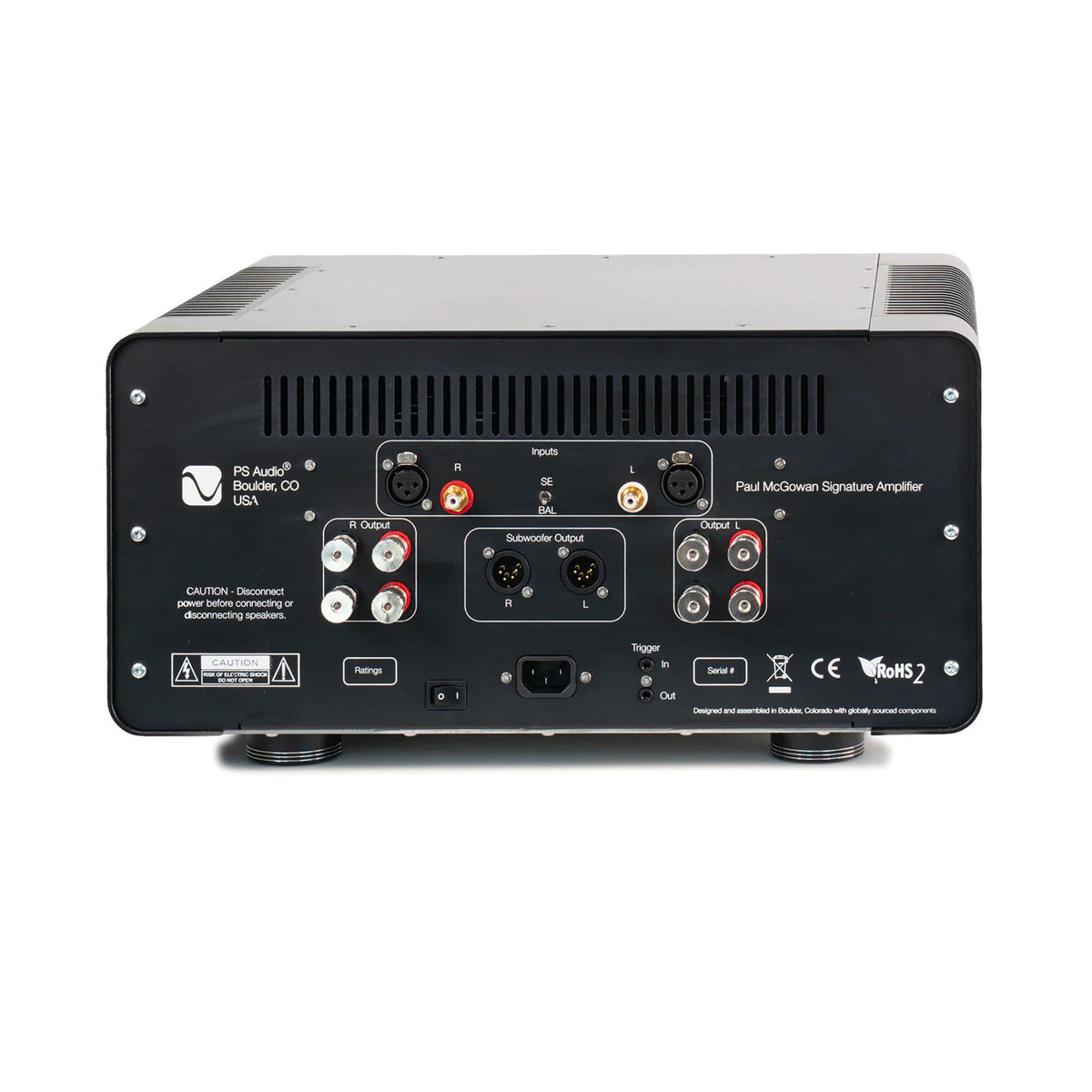
1 × RCA (Single-ended), 1 × XLR (Balanced)
Speaker Outputs
4 pairs of silver-plated binding posts
Trigger
Input
3.5mm (5–15VDC) • Output
3.5mm (12VDC)
Gain
26.2dB
Input Sensitivity
2.0V
Power Output
200W per channel into 8Ω, 400W per channel into 4Ω (1kHz, <1% THD)
Class A Power Output
10W per channel into 8Ω
Frequency Response
<10Hz – 80kHz (±0.25dB)
Input Impedance
100kΩ (Single-ended), 200kΩ (Balanced)
Bandwidth
>500kHz
Total Harmonic Distortion (THD)
<0.002% typical (20Hz–20kHz, 1W/8Ω)
Damping Factor
>240 at 8Ω (20Hz–1kHz)
Crosstalk
>90dB at 1kHz
Choose options