

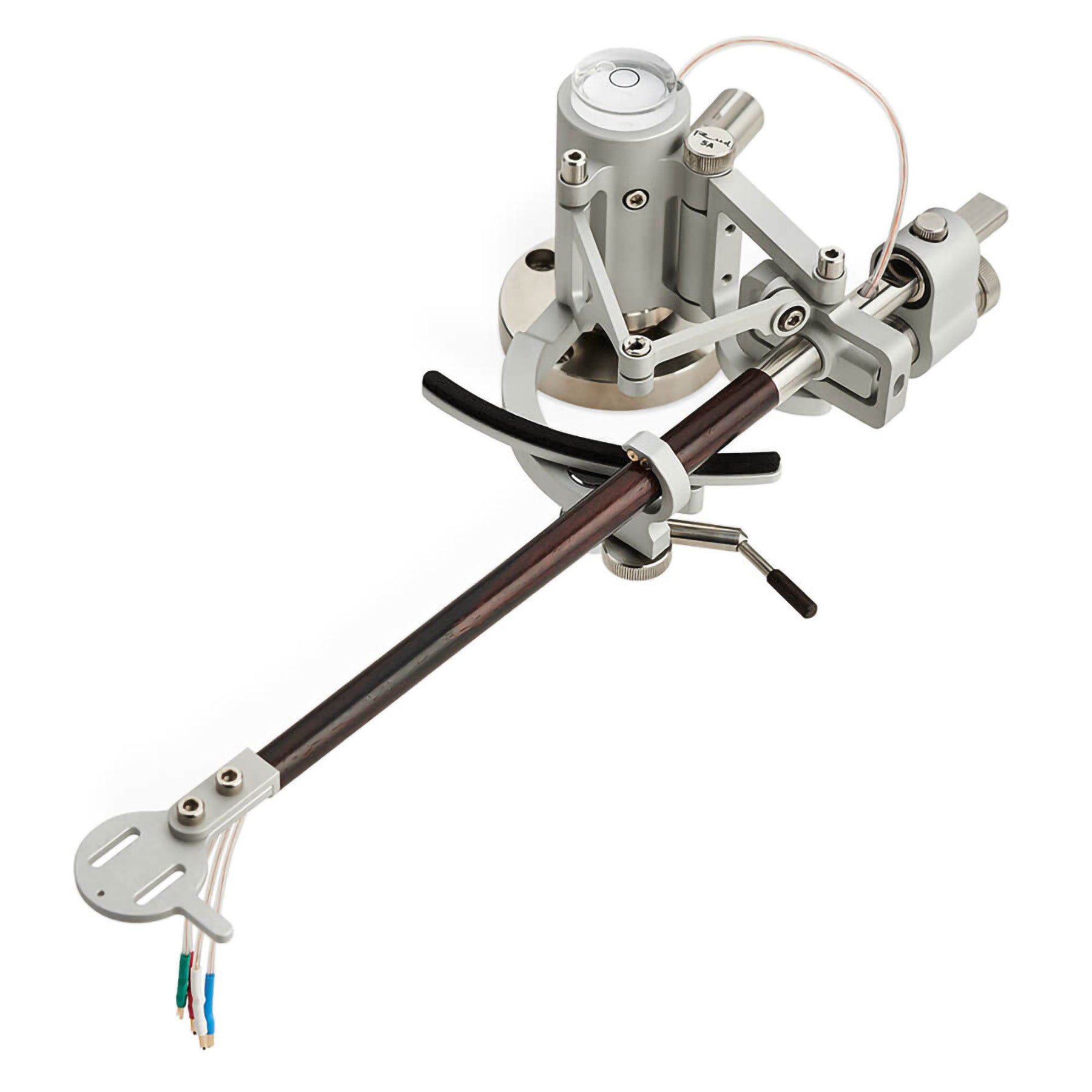


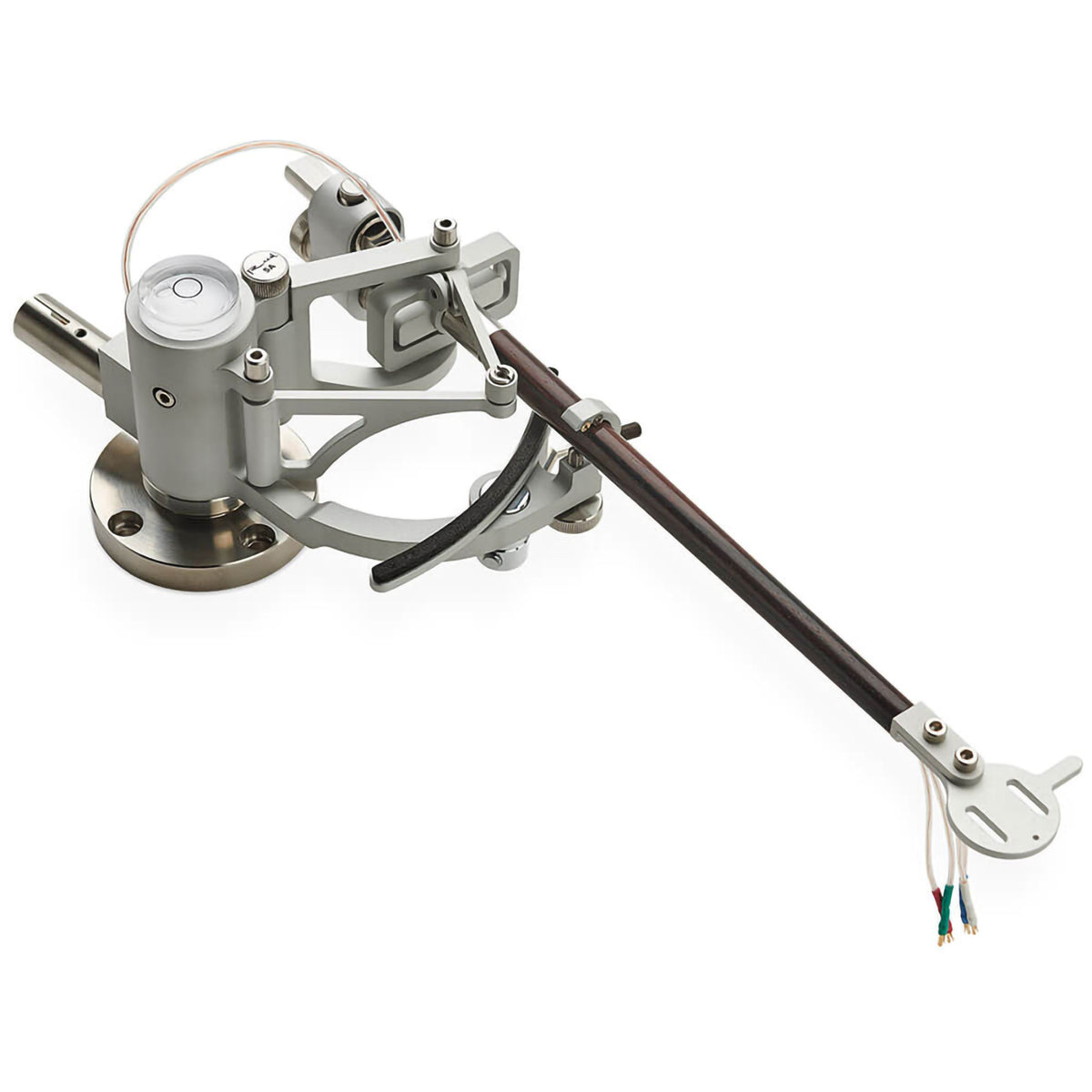

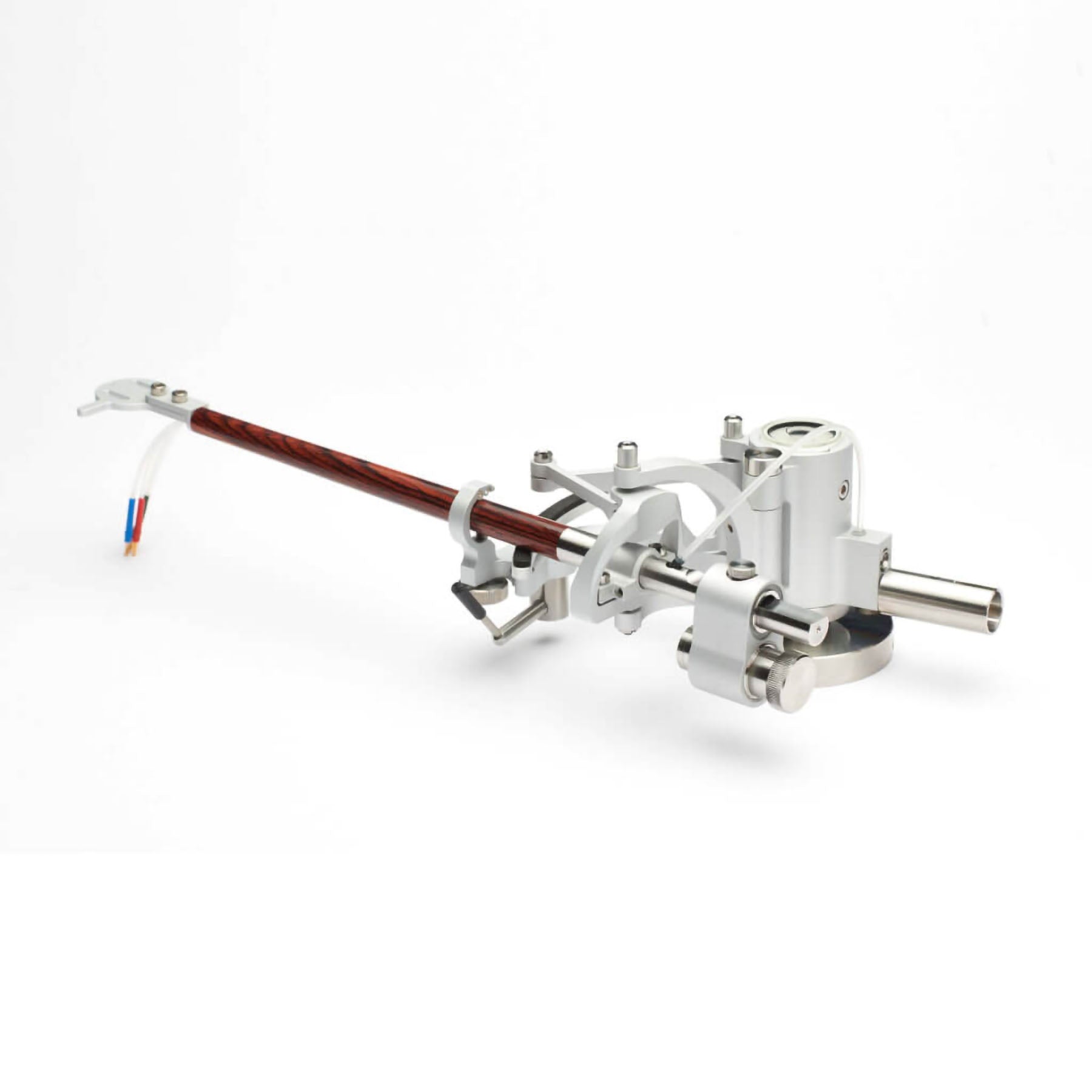

Reed 5A Tangential 90 Degree Pivot Reference Tonearm
Reed 5A tonearm introduced as angling- 90degree -tangential-pivot-tonearm, it is based on Double Birch/Thales geometry and will complement our tangential tonearm lineup.
Below is the scheme of Double Birch/Thales geometry ( Fig.1). Tonearm geometry is optimized for minimal tracking error.
If the Reed 3P has taken the traditional radial tonearm design to the highest level of evolution, how can you then improve the sound? The logical progression is to create a well-designed tangential-pivot tonearm!
The Reed 5A is the fourth offering in the Reed tonearm range and elevates sonic performance to a rarified level only possible with tangential tonearm designs which allow the cartridge to track true – at 90° to the grooves. The Reed 5A is based on the Double Birch/Thales geometry which is a very sound approach, however the challenge is that for this tonearm to reach the performance potential that this design is capable of, the design needs to be perfect and the engineering needs to be flawless. This is where Reed’s manufacturing capabilities come to the fore. Below is a diagram showing the Double Birch/Thales geometry. A tonearm that follows this geometry is optimised for minimal tracking error.

The operating principle of this tonearm is also illustrated in this short video.
To better understand the Double Birch/Thales geometry, please note:
- P1, O1, P3 are Thales’ semicircles
- P1-A1-P3, P1-A2-P3, P1-A3-P3 angles are 90⁰ each
- A1,1B1 = A2,1B2= A3,1B3 segments represent tonearm length
- 1B is the vertical axis of the tonearm
- 1P2 is the center of the circle, which is drawn through three points -1B1,1B2,1B3 – axis of rotation of the back link component
- 2P2 – center of the circle, which is drawn through three points -2B1,2B2,2B3 – axis of rotation of the front link component
- 1B1,2B1 = 1B2,2B2 = 1B3,2B3 – tonearm lever
In the Reed 5A, the armtube suspension system is similar to the one used in Reed 3P tonearm. The tonearm’s back link uses low-noise ceramic rolling bearings. The lever uses a low-noise ceramic rolling bearing and rests on the sapphire / molybdenum carbide thrust bearing. The sapphire / molybdenum carbide thrust bearings are also used for the tonearm’s front link, vertical and horizontal axes. The tonearm has VTA and azimuth setup and can be configured with a Reed or SME (universal headshell connector) headshells.
To make sure the tonearm setup is precisely horizontal, the tonearm has an integrated level and horizontal plane adjuster. In comparison to regular pivot tonearms, the Reed 5A does not require antiskating and has much less absolute tracking error.
For example,
- Regular pivot tonearms measure approx. 1.2 – 2.5 deg of absolute tracking error (Fig.3).
- The Reed 5A has a max. tracking error of ±4 Minute of Angle (MOA) (Fig.2).

Figure 2

Figure 3
Perhaps the greatest feature is that compared to other tangential tonearms, the Reed 5A does not require any additional devices to work (e.g. compressors, electronic controllers) and hence avoids the challenges of introducing those devices. It is also very compact and can be easily mounted on a wide range of turntables.
Like a well-played symphony from one of the masters, the Reed 5A has that rare genius quality, that unmistakable elegant simplicity that belies the sheer talent & know-how that went into its composition. The minimal tracking error performance translates to a clarity and effortlessness to the sound, as if the music flows with no friction or resistance, unleashed to dance around the room with unbridled freedom. Even the sight of a 5A mounted on a great turntable elevates levels of excitement, passion and anticipation. Then, the instant the stylus is gently placed in the groove and the music begins to flow, there’s an acknowledgement of that genius. The tonal beaty, pace, rhythm and timing…..the realism and emotional intent that radiates in all directions is hypnotic and reminds you why you got into this hobby in the first place.
Videos
Reed 5A tangential tonearm
How does Reed 5A tonearm work?
SAMPLES OF FINISH
Pictures below are for illustration of finishing only; tonearm model may be different from described above.
Black

Seashell White

Armwood Wood Samples
Wenge

Macassar Ebony

Cocobolo

Teak Light

Teak Dark

Approximate effective mass of Reed tonearm in grams. Armwand’s effective mass can be adapted to customer’s needs in a range of 8-18 grams.
Armwand
Wenge
10-14
Makassar ebony
10-16
Cocobolo
12-16
Teak (light, dark)
8-12
Product Specifications
Mounting Distance
251 mm (maximum platter diameter = 330 mm)
Tracking Error
±4 minutes of angle (MOA)
Effective Mass
10–16 g (depending on the armwand material)
Height Adjustment
Compatible with 26–46 mm height platters
VTA Adjustment
Precision ±0.2 mm
Azimuth Adjustment
±8°
Downforce Range
10–30 mN (compatible with cartridge mass 5.5–19.5 g; 4.0–25.0 g)
Offset ang
0 deg. 0mm
Integrated Level Accuracy
+/-2 mm/m
Choose options